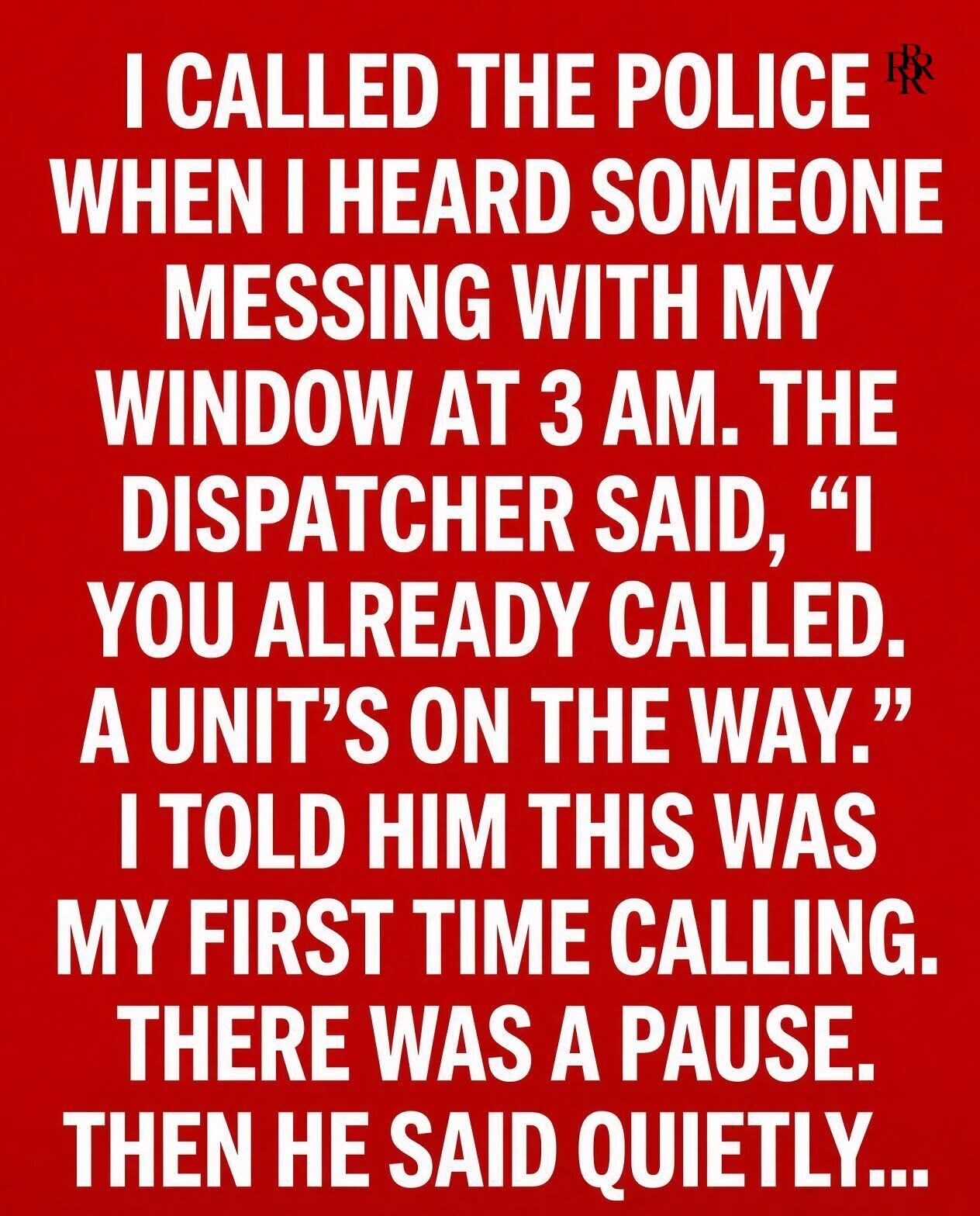
The sound came again at exactly 3:07 in the morning. Three soft taps against the bedroom window. I had been awake for nearly twenty minutes, lying perfectly still beneath my blankets and telling myself it was probably a tree branch moving in the wind. But there was no wind that night. The curtains were closed, the house was silent, and every room beyond my bedroom was dark. Then came another sound—a faint scraping noise, as if someone were dragging their fingers across the glass. My name is Evelyn Harper, and I had lived alone in that little white house on Maple Street for almost eleven years. I was sixty-four years old, recently retired from the county library, and I had always considered myself sensible. I checked the locks twice before bed. I kept a porch light on every night. I knew my neighbors well enough to recognize their cars. But nothing had prepared me for the feeling that settled into my chest when I finally gathered the courage to pull back the curtain and saw the faint outline of someone standing beside my bedroom window. I didn’t scream. I couldn’t. My body seemed to forget how to move. The figure disappeared before I could focus on a face, leaving only darkness and my own reflection trembling in the glass. I reached for my phone and called the police. The dispatcher answered calmly, asking for my address and the nature of the emergency. I explained that someone had been outside my window. Then he interrupted me. “Ma’am,” he said slowly, “you already called. A unit is on the way.” I sat up in bed. “No,” I whispered. “This is my first time calling.” There was a long pause. When the dispatcher spoke again, his voice had changed. “Please stay inside, lock your doors, and do not approach any windows. Officers will be there shortly.” I wanted to ask who had called before me, but he ended the conversation after assuring me help was coming. Ten minutes later, red and blue lights reflected across my bedroom walls. Two officers knocked on my front door. I opened it only after seeing their uniforms through the peephole. One officer searched around the house while the other sat with me at my kitchen table. His name was Officer Ramirez. He was young, polite, and far too serious for a call about a possible prowler. “Mrs. Harper,” he said, “the first call we received came from a woman who said she was watching your house.” My hands tightened around my coffee mug. “Watching my house?” He nodded. “She said she saw a man standing near your bedroom window and believed you might be in danger.” I stared at him. “Who was she?” Officer Ramirez looked toward his partner, who had just returned through the back door. “That’s what we’re trying to find out,” he said.
The officers found footprints beneath my bedroom window, but the ground was too dry to reveal much more than the shape of a heavy work boot. They searched the backyard, checked behind the garage, and shone flashlights through the narrow alley that separated my property from the old house next door. Nothing. No man. No weapon. No sign of forced entry. Before leaving, Officer Ramirez gave me his card and told me to call immediately if I noticed anything unusual. I barely slept after they left. By sunrise, I had convinced myself that the entire thing would become one of those strange stories people tell at family gatherings. Then, at 8:16 that morning, my doorbell rang. Standing on my porch was my younger sister, Marianne. She lived nearly two hours away and had not visited without calling first in years. Her face was pale. “Are you all right?” she asked before I could say anything. “Why wouldn’t I be?” I replied. She looked past me into the house. “I heard there were police cars here last night.” My stomach tightened. “How did you hear that?” Marianne hesitated for one second too long. Then she said she had seen something online. A neighborhood group, perhaps. But there was no neighborhood group where people posted police activity at three in the morning, and Marianne didn’t use social media. I invited her inside anyway. We sat at the kitchen table where the officers had sat hours earlier, and I told her everything. When I reached the part about the mysterious woman who had called before me, Marianne’s face changed. She looked down at her hands. “Evelyn,” she said quietly, “there’s something I should have told you a long time ago.” Those words can change the temperature of a room. I felt myself go cold. Marianne explained that after our mother died, she had discovered an old box hidden in the attic. Inside were letters, photographs, and documents concerning someone named Clara Bennett. I had never heard the name. Marianne said Clara had once been our mother’s closest friend. More than that, she had lived with our family briefly when I was a child. “You were too young to remember,” Marianne told me. “But Mom believed Clara saved your life.” According to the letters, when I was six years old, I wandered away from a family picnic near the river. Clara had found me before I reached the water. After that, she became almost like another member of our family. Then, suddenly, the letters stopped. Our mother never spoke about her again. Marianne found one final envelope addressed to me in our mother’s handwriting, but she had been afraid to give it to me. “Why?” I asked. My sister began to cry. “Because Mom wrote that if Clara ever came looking for you again, it meant something terrible had happened.”
That afternoon, I opened the envelope Marianne had carried in her purse for nearly twelve years. The paper inside was yellowed, but I recognized my mother’s handwriting immediately. She explained that Clara Bennett had been more than a friend. Clara had once been married to a man named Thomas Bennett, a man who had become increasingly violent after losing his job. Our mother helped Clara escape him. For years afterward, Thomas blamed our family for helping her disappear. He was eventually arrested for another crime and sentenced to prison. The letter said Clara had changed her name and moved away, but she had remained in occasional contact with my mother. Then came the sentence that made my hands shake: Thomas had repeatedly asked about me. Apparently, he remembered the little girl Clara had saved by the river and had convinced himself that my family somehow owed him for the life he believed had been ruined. My mother wrote that she had spent years hoping he would forget us. At the bottom of the letter was a note written only months before her death. Thomas was scheduled to be released from prison. “If anything ever feels wrong,” my mother had written, “trust your instincts. And if someone named Clara tries to protect you, listen to her.” I read that sentence three times. Then I remembered the dispatcher. A woman had called about a man outside my house before I did. A woman had been watching my house. Marianne and I immediately called Officer Ramirez. Within an hour, detectives arrived and took copies of the letter. They asked whether I had noticed anyone following me recently. At first, I said no. Then I remembered the gray pickup truck I had seen parked across from the library during my final week of work. I remembered a man standing in the grocery store aisle behind me. I remembered finding my garden gate open twice even though I always latched it. Each memory seemed harmless alone. Together, they formed a pattern I could no longer ignore. The detectives placed a patrol car near my street that night. Marianne refused to leave. We sat in my living room with every lamp turned on, pretending to watch old movies while listening for sounds outside. At 11:43, my phone rang. The number was blocked. I almost ignored it. Then something inside me said to answer. “Hello?” For several seconds, nobody spoke. Then a woman whispered, “Don’t turn around.” My blood froze. “Who is this?” “My name is Clara,” she said. “And the man watching your house knows you’re not alone tonight.”
I wanted to scream, but Clara told me to stay calm. She said she had spent the last several weeks following Thomas from a distance after learning he had been released. She had recognized him near my neighborhood and knew exactly why he was there. “I should have told you sooner,” she said. “I was afraid he would see me contact you.” I asked where she was. She wouldn’t say. Instead, she told me to look toward the old house next door. The curtains were drawn, but one upstairs window showed the faintest flicker of light. My neighbor’s house had been empty for months. Marianne gripped my arm. Before I could move, headlights swept across the street. A police car slowly turned the corner. Then everything happened at once. A man burst from behind the empty house and ran toward the alley. Officers shouted. Another patrol car blocked the road. I heard footsteps, commands, and then the sound of someone being forced to the ground. Marianne and I remained inside until Officer Ramirez knocked on the door twenty minutes later. Thomas Bennett had been arrested behind the abandoned property. In his backpack, police found photographs of my house, a notebook listing my daily routines, and several pages containing details about me that no stranger should have known. But there was something else. A photograph taken from across the street showed me standing on my porch two weeks earlier. In the corner of the picture, partially hidden behind a tree, was another person. A woman. Clara. She had been watching him watch me. She had protected me without asking for recognition, just as she had done when I was six years old and standing too close to a river I never remembered. I asked Officer Ramirez if Clara was safe. He said officers had searched for her, but she had disappeared before they arrived. “She may contact you again,” he said. I went to bed before dawn, but sleep didn’t come easily. At 6:30, I heard the mail slot open. One envelope slid across my hallway floor. There was no stamp. No return address. Inside was a single photograph of two little girls standing beside a riverbank. One was me. The other was a young woman with dark hair, smiling down at me. On the back, someone had written, You were always worth protecting.
For months afterward, I wondered whether I would ever see Clara again. Life slowly returned to normal. Thomas remained in custody while investigators uncovered enough evidence to keep him far away from me. Marianne and I grew closer after years of treating each other like relatives who happened to share childhood memories. She apologized for keeping our mother’s letter hidden. I forgave her because fear makes people carry secrets they were never meant to hold alone. One Sunday afternoon, almost a year after the night at my window, I visited the river where our family used to picnic. I brought flowers for my mother and placed them beneath an old tree overlooking the water. As I turned to leave, I saw a woman sitting on a bench near the parking lot. She was older than I expected, with silver hair and a familiar warmth in her eyes. Neither of us spoke at first. Then she smiled. “You still stand too close to the water.” I laughed and cried at the same time. Clara and I spent three hours talking that afternoon. She told me she had followed my life from a distance because she had never stopped caring about the little girl whose hand she had once held beside the river. She had watched my mother grow older, had learned about my career at the library, and had known when I bought my little house on Maple Street. I should have been angry that someone had known so much about me, but when she explained the years of fear surrounding Thomas, I understood why she had remained in the shadows. Still, I made her promise that if she ever wanted to be part of my life again, she would do it honestly. No more watching from across the street. No more mysterious phone calls. She laughed softly and agreed. That Christmas, Clara came to dinner with Marianne and me. We set an extra place at the table, and for the first time, I heard stories about my mother that I had never known. Stories about courage, friendship, and the quiet sacrifices people make when nobody is looking.
Looking back, I sometimes think the strangest part of that night was not the sound at my window. It was learning that help had already arrived in another form before I even knew I needed it. For years, I believed my life was simple. I was a retired librarian living alone in a quiet house, surrounded by familiar streets and ordinary routines. But beneath that ordinary life were old promises, buried secrets, and people who had carried pieces of my story without my knowledge. My mother had tried to protect me by keeping the past hidden. Marianne had tried to protect me by holding onto a letter she didn’t know how to share. And Clara had protected me by stepping into danger rather than allowing a man from her past to harm someone she still remembered as a child. That night taught me that fear can make people hide the truth, but love can make them return to it. I still check my locks before bed. I still leave the porch light on. But I no longer feel quite so alone in that little white house on Maple Street. Clara visits for coffee now, and Marianne calls every Sunday. Sometimes we sit together and laugh about how close we came to never knowing one another properly. And whenever I hear a sound outside my window late at night, I remember the dispatcher saying that someone had already called. Back then, those words terrified me. Now they remind me of something very different: sometimes, before we even realize our lives are in danger, someone who cares about us has already noticed the darkness gathering nearby—and has already started finding a way to bring us safely back into the light.
