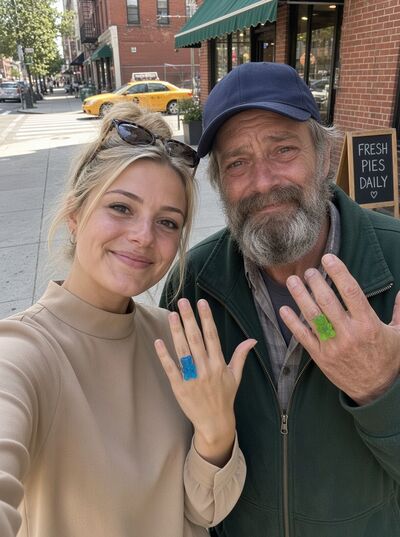
I read the last page three times before I could put it down. Then I sat behind the counter of the little coffee shop, staring at the cardboard sign he had carried for years. It said, “Anything helps. God bless.” The edges were soft from rain, the writing had faded, and one corner was held together with yellowing tape. I had kept it because I thought it was the only thing I could preserve from Douglas. Now I understood that it had been more than a sign. It had been the only way he knew how to introduce himself to the world. My father had been standing outside my shop every morning, watching me unlock the door, arrange the chairs, and put the coffee on. He had been close enough to hear me laugh with customers and far enough away to pretend we were strangers. I remembered the first morning I noticed him. It was January, bitterly cold, and he wore a thin brown coat with a missing button. I had brought him a cup of coffee without asking whether he wanted one. He looked at me for a long moment before accepting it. “Thank you, miss,” he had said. I remembered thinking his voice sounded familiar, but I had never imagined why. For three years, I had called him Douglas because that was the name he gave me. I had learned that he liked his coffee black, that he never wanted sugar, and that he always folded the cardboard sleeve into a tiny square before leaving. I had also learned not to ask where he slept. Some mornings he arrived clean-shaven. Other mornings, his beard was several days old, and his hands shook so badly that I placed the cup on the bench beside him. He never complained. He never asked for anything beyond the coffee. And now I knew that every ordinary morning had been a moment in which my father stood in front of his daughter and chose silence because he believed the truth would destroy the only connection he had left.
I closed the shop early that afternoon and took the handwritten pages home. My apartment was quiet, except for the ticking clock above the kitchen door. I made tea, spread the pages across the table, and began reading from the beginning. There were dates, memories, and explanations he had apparently written over several months. He described the night he left Pittsburgh. He had been drinking, arguing with my mother, and making promises he knew he couldn’t keep. He wrote that he remembered me standing in the hallway wearing yellow pajamas, holding a stuffed rabbit by one ear. I had asked him whether he would be home for breakfast. He had said yes. He wasn’t. He admitted that he had tried to return twice during the first year, but both times he was drunk and ashamed. My mother refused to let him inside. By the time he became sober enough to understand what he had done, she had moved, changed her number, and begun telling people he was dead. He wrote that he couldn’t blame her. He had given her every reason to protect me from him. But the most painful pages were not about the past. They were about the day he recognized me outside the coffee shop. He had seen my name on the sign above the entrance: “Maggie’s Corner.” He had known my face immediately, even though I was now a grown woman with my mother’s eyes and his hands. He had stood across the street for nearly an hour, unable to move. Then he came back the next morning. And the next. He wrote that he wanted to tell me everything, but every time he opened his mouth, he remembered the little girl waiting in the hallway for a father who never returned. He feared that if he told me the truth, I would see only the man who had abandoned me. So he accepted the coffee, thanked me politely, and allowed me to believe he was simply another lonely man who needed somewhere warm to sit. One sentence was underlined twice: “I know I have no right to ask her to love me, but for three years she gave me kindness without knowing she was giving it to her father.” I pressed the page against my chest and cried until my tea went cold.
The next morning, I called the attorney whose name appeared on the final page. His name was Mr. Franklin, and he had handled Douglas’s insurance paperwork. He confirmed that the policy had been active for nineteen years. Douglas had paid the premiums whenever he could, sometimes sending money through an agency, sometimes making payments after temporary jobs. The policy was small at first, but its value had grown over time. He had named no beneficiary because he had no reliable contact information for me and believed my mother had legally removed him from my life. The marriage certificate had allowed the claim to be processed through the legal arrangement he had established with the attorney. I asked why he had married me. Mr. Franklin gently corrected me. “He didn’t marry you, Maggie. He married the idea of making sure you could receive what he had left behind. The marriage was a legal arrangement with another person who helped him establish the claim. You were the intended recipient of the money, not his spouse.” I felt embarrassed by my misunderstanding, but he reassured me that the paperwork had been complicated. Then he told me something that made me cry again. Douglas had refused to spend almost anything on himself during the final years. He had lived in shelters, worked odd jobs, and sometimes skipped meals to keep the policy active. He had never believed the money would make up for his absence. He simply wanted to leave me something that could help me build a life that did not depend on anyone else’s generosity. I asked whether he had spoken about me. Mr. Franklin said he had talked about me constantly. He knew I had opened the coffee shop after leaving my office job. He knew I had once considered closing it because the rent was too high. He knew I had started serving free coffee to people who slept outside the subway station. He had watched me from the opposite pavement and quietly celebrated every small success. Before we ended the call, the attorney said, “Your father was not proud of the way he lived, Maggie. But he was proud of the person you became.” I thanked him and sat at my kitchen table for a long time. Sixty-one thousand dollars was a life-changing amount of money for someone like me. But the thought that my father had spent nineteen years preparing it while believing he might never be forgiven was almost impossible to carry.
For eight months, I couldn’t decide what to do with the money. I kept it in a separate account and avoided looking at the balance. Friends told me to pay off my apartment, buy a better car, or take a vacation. I understood why they suggested those things. I had worked hard, and I deserved some comfort. But every time I imagined spending it on myself, I saw Douglas sitting outside the shop with his thin coat and folded cardboard sign. I began visiting the shelters he had mentioned in his letters. I spoke to people who had known him, including a retired nurse named Helen who remembered him bringing donated blankets to the shelter even when he barely had enough clothing for himself. She told me that he had once refused a winter coat because another man was shivering more than he was. “He wasn’t an easy man,” she said. “He carried a lot of sadness, and sometimes he made choices that hurt people. But near the end, he tried to be useful.” I asked whether he ever talked about his daughter. Helen smiled sadly. “Every time someone mentioned family, he’d look toward the door. I think he hoped you might walk in one day.” I returned to the shop and looked at the empty corner where he used to sit. That was when I finally understood what I wanted to do. I wasn’t going to build a monument to him or put his name on a plaque. I wanted to create the kind of place he had needed. A warm room where someone could sit without being questioned about their money, their past, or the reason they had nowhere else to go. I found a small storefront near the subway, only a few blocks from my coffee shop. It had been empty for years, with dusty windows and a broken sign. I used part of the money to rent it, repair the heating, install comfortable chairs, and build a simple counter where we could serve coffee, soup, and sandwiches. I called it The Open Door. The first day we opened, only three people came in. One was an older man carrying two plastic bags. Another was a woman who had been sleeping in her car. The third was a young man who said he had lost his job and didn’t know where to go. I welcomed all three. Nobody had to buy anything. Nobody had to explain themselves. I remembered the way Douglas had looked when I first handed him a cup of coffee, and I understood that sometimes the smallest kindness is the one a person remembers for the rest of their life.
It took almost a year before I could read the final pages without crying. By then, The Open Door had become part of the neighborhood. Volunteers helped prepare meals, a retired teacher offered free help with job applications, and a local barber began coming twice a month to give haircuts. We kept a small shelf with donated gloves, socks, scarves, and toiletries. There were forty-two regular visitors by the time winter returned. I learned their names, their favorite drinks, and the little details that made them feel less invisible. One man always asked for two sugars but never stirred his coffee. A woman named Patricia liked to sit near the window because she enjoyed watching the buses. A young father brought his daughter every Saturday, and she had become very good at drawing pictures for the volunteers. I began to understand that the money Douglas left me was not simply an inheritance. It was an opportunity to turn something painful into something useful. Then, one cold morning, a man entered carrying a cardboard sign. He was thin, exhausted, and visibly uncomfortable. He stood near the entrance as if he expected someone to tell him to leave. I walked over and asked whether he wanted coffee. He looked suspiciously at me. “How much?” he asked. “Nothing,” I replied. “You can sit as long as you need.” He hesitated before accepting the cup. His hands were trembling. I brought him a bowl of soup and a sandwich, then sat at a nearby table without asking questions. After a while, he told me his name was Peter. He had lost his apartment after a workplace injury and had been sleeping wherever he could find shelter. He had stopped visiting cafés because he couldn’t afford to buy anything. I told him he was welcome to return. He looked at the room, then at me. “Why do you do this?” he asked. I thought about giving him a long explanation, but I decided to tell him the truth. “Someone once spent a lot of time sitting outside a warm place, believing he didn’t deserve to come inside. I don’t want anyone else to feel that way here.” Peter nodded, and for the first time, his shoulders relaxed. That evening, I placed a framed photograph of Douglas on the shelf behind the counter. It wasn’t a perfect photograph. He was wearing his old brown coat, looking slightly away from the camera, with one hand resting on the cardboard sign. Beneath it, I wrote a simple sentence: “Everyone deserves a place to sit.”
I still keep his handwritten pages in a wooden box at home, wrapped in the same envelope in which the attorney delivered them. I don’t display them at The Open Door because they belong to a private part of my life. But I keep the cardboard sign behind the counter, where anyone who asks can see it. Sometimes people assume it is a reminder of poverty. I tell them it is a reminder that we rarely know the whole story of the person standing in front of us. My father made terrible mistakes. He hurt my mother, abandoned his daughter, and spent years allowing shame to keep him away. I will never pretend those things didn’t happen. There are still days when I wish he had walked through the door and told me the truth while he was alive. I wish I could have called him Dad, asked him about his childhood, and heard him laugh without wondering whether he was about to disappear again. But I also know that the last three years of his life were not entirely empty. Every morning, I gave him coffee. Every morning, he sat somewhere warm. And every morning, even without knowing who he was, I treated him like a person who mattered. I used to think the sixty-one thousand dollars was the most important thing he left me. Now I know it wasn’t. The money helped me open a door, but the handwritten pages taught me why that door needed to stay open. They showed me that people can spend years believing they are beyond forgiveness, that regret can make someone disappear, and that kindness can reach a person even when the truth remains unspoken. I cannot give my father another chance to be my father. I cannot return to the little apartment in Pittsburgh or change the morning he walked away. But I can decide what happens next. So every morning, I unlock The Open Door, turn on the lights, and put a fresh pot of coffee on. The first cup is always left on the counter, free for whoever needs it. Sometimes I imagine Douglas sitting in his old chair, folding the cardboard sleeve into that tiny square. I imagine him looking around the room and seeing forty-two people who know they are welcome. And I hope that, wherever he is, he finally understands something he struggled to believe while he was alive: he did not have to spend the rest of his life earning the right to be seen. He already mattered. And because he mattered, the kindness he left behind continues to reach people he never had the chance to meet.
