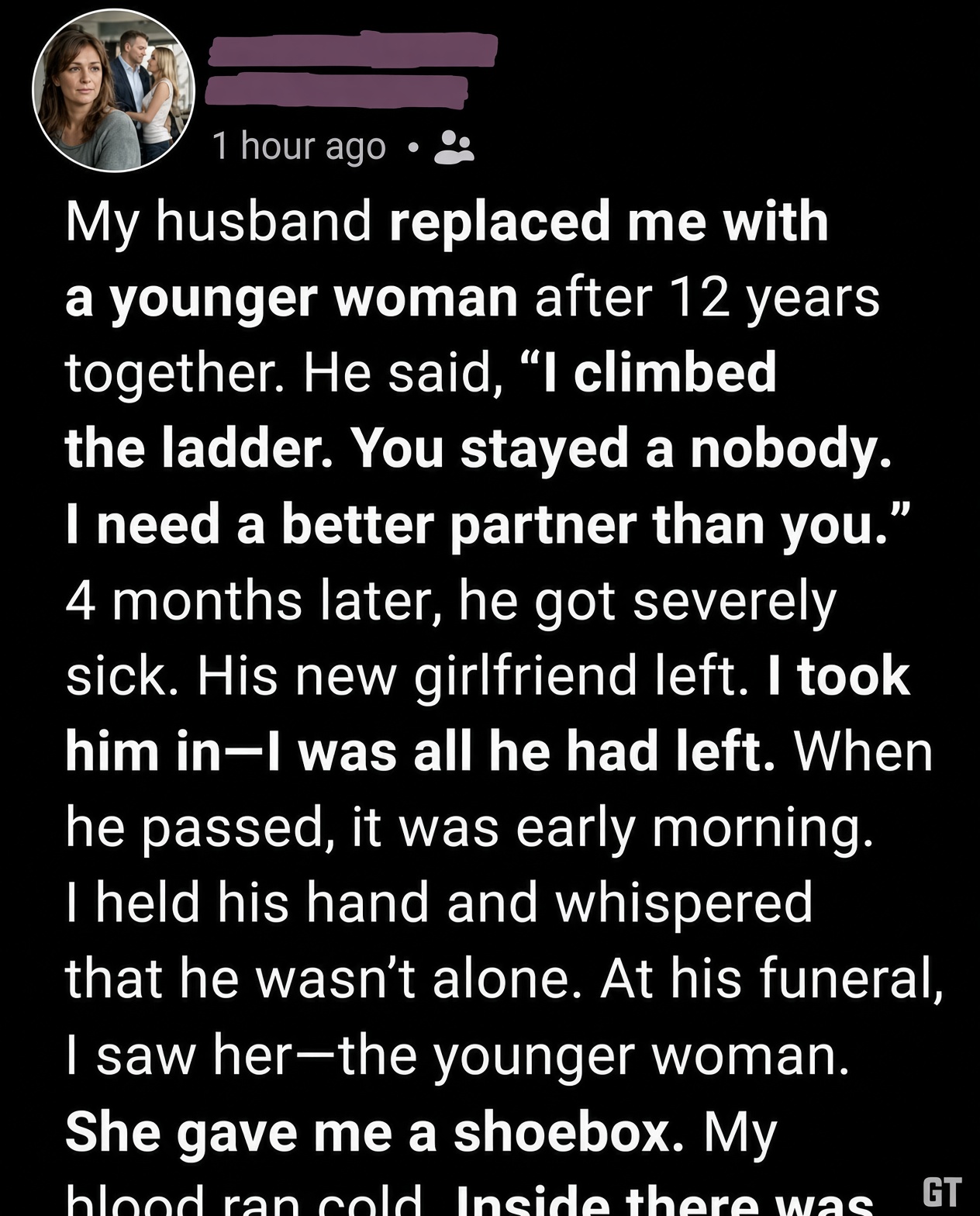
I had not planned to go to the funeral. For four months I had cleaned his wounds, managed his medications, and sat beside the hospital bed while machines beeped and the younger woman never once appeared. When the call came at 4:17 a.m. that he was gone, I held his hand until the nurse gently moved me aside. The funeral director later told me the service would be small. I arrived late, stood at the back in a black coat that still smelled faintly of the antiseptic I had used on his sheets, and watched the handful of coworkers and distant cousins file past the closed casket. Then she walked in. She wore a fitted charcoal dress and carried a plain brown shoebox the size of a ream of paper. She did not cry. She waited until the last mourner left, crossed the aisle, and set the box in my hands without a word. My fingers went cold before I even lifted the lid.
Inside, under a layer of tissue paper, were forty-seven letters, all in his handwriting, all addressed to me, all dated after the day he moved out. They were not apologies in the ordinary sense. They were inventories. He listed the exact moments he had rehearsed the speech about climbing the ladder, the nights he had practiced it in the bathroom mirror so it would sound spontaneous, the amount he had transferred into a separate account so she could book the trips and the restaurants that would make the new life look effortless. He described watching me, from the apartment window across the street, the first evening I came home alone and stood in the kitchen longer than necessary before turning on the light. He wrote that he had wanted to feel powerful and that the power had lasted eleven days. After that the letters grew shorter. He catalogued the first night she stayed out past midnight without answering, the first time she looked at his face when he coughed and did not reach for him, the afternoon she told him the apartment felt smaller with both of them in it. The final letter, written three days before he called me from the emergency room, said only: “If she leaves, do not let me die alone. I have already done that to you once.”
I carried the box home and spread the pages across the dining table that still held the faint ring where his coffee mug used to sit. Reading them in order took most of the night. Between the letters were other items: a single house key on a plain ring, a folded bank statement showing the account he had emptied and then slowly refilled once he understood she would not stay, and a sealed envelope marked “For the funeral.” Inside that envelope was a short note in his hand and a cashier’s check made out to me for the exact amount he had spent on the first three months of the new relationship. The note said the money was not restitution; it was the cost of the performance he had asked me to watch. He asked that I use it however I chose, including throwing it away. At the bottom he had written the date he first noticed the younger woman’s eyes slide past him when another man entered the room, and the date, four months later, when he finally stopped pretending he had not seen it.
By morning the letters were stacked again, the check still uncashed, the key lying on top. I made coffee in the same mug whose ring marked the table and stood at the window the way he had described watching me. The street was ordinary. Cars passed. Someone walked a dog. Nothing in the view explained why he had needed an audience for his own departure or why, once the audience was gone, he had written every line as if the only person who could still hear him was the one he had already discarded. I did not call the younger woman. I did not return the box. I placed the key in a drawer, the check in a folder I labeled with the year, and the letters in the same shoebox she had handed me. Then I opened the kitchen window, let the morning air move across the table, and began the ordinary work of clearing the space where the ring of the mug had been, one slow circle at a time, until the wood looked unmarked again.
